To build a Telegram bot for business, register the bot with BotFather to get an API token, then build the service behind it: map the conversation flows, choose scripted logic or AI, connect a database, payments, and your CRM, add an admin panel, and launch by sharing a link. The registration takes minutes; the service is the project.
This guide unpacks each step, including the parts most tutorials skip. If you are here to commission a bot rather than code one, start with our Telegram bot development service — every example below is a bot we built and still run — or the wider picture on our chatbot development page.
What a Telegram Bot Is, Technically
Registration is the trivial part: you message BotFather, choose a name, and receive a token — an empty shell, a username people can write to with nothing on the other end.
The actual bot lives on your server. It is a backend application talking to the Telegram Bot API: when a user sends a message or taps a button, Telegram forwards that update to your application — in production over a webhook, an HTTPS endpoint Telegram calls the instant something happens; development setups use simpler long polling. Your code decides and calls the API back: reply, show a menu, request a payment.
Everything past that is ordinary web engineering. Telegram renders the entire interface — chat, buttons, inline keyboards — so there is no frontend to build. But there is state to manage: who each user is, where they stand in a flow, what sits in their cart. That means a database, plus the payment provider, CRM, or order system the bot transacts with. The accurate mental model: a Telegram bot is a small web product whose UI Telegram already shipped.
Two Decisions Before You Write Any Code
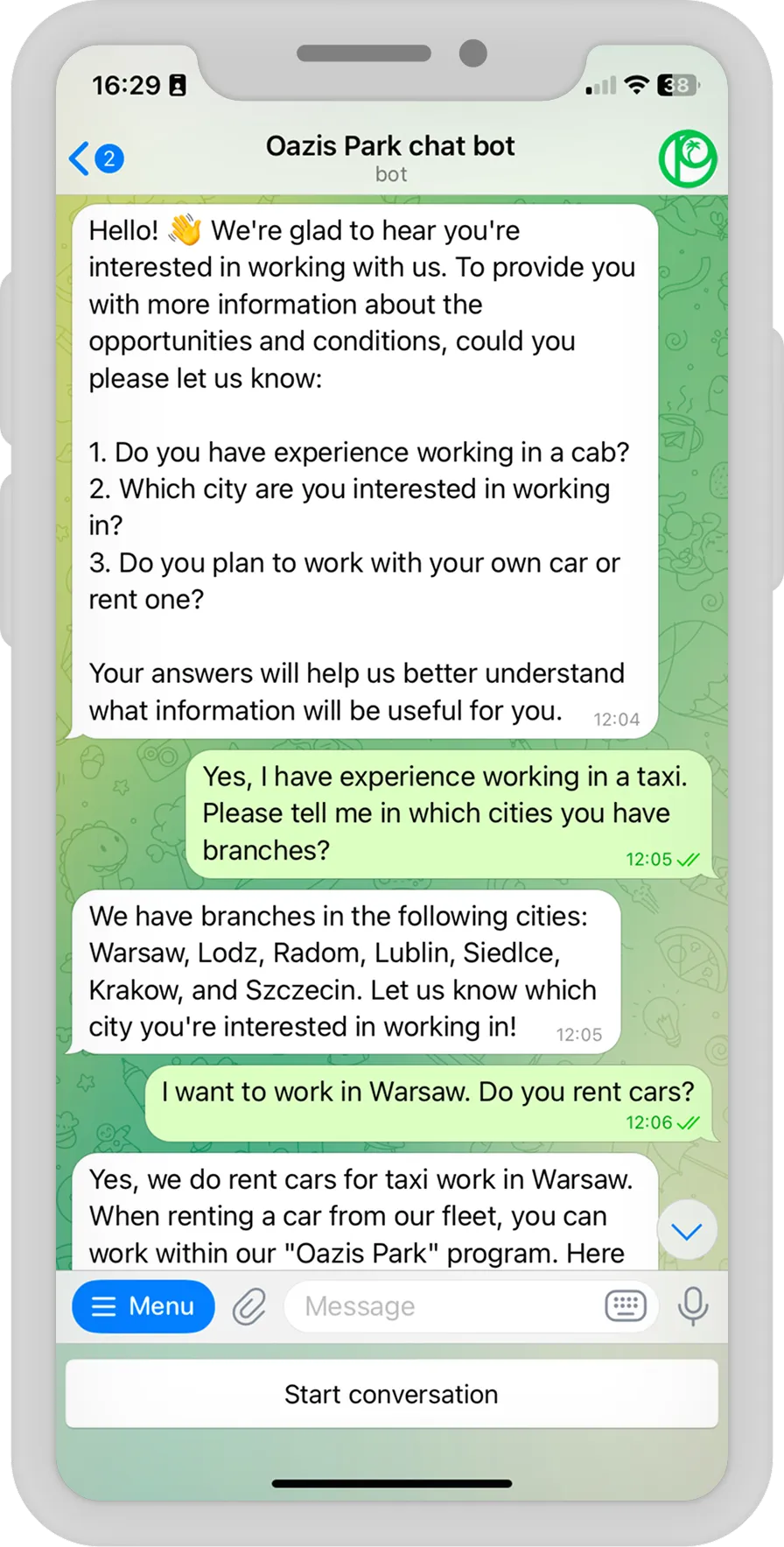
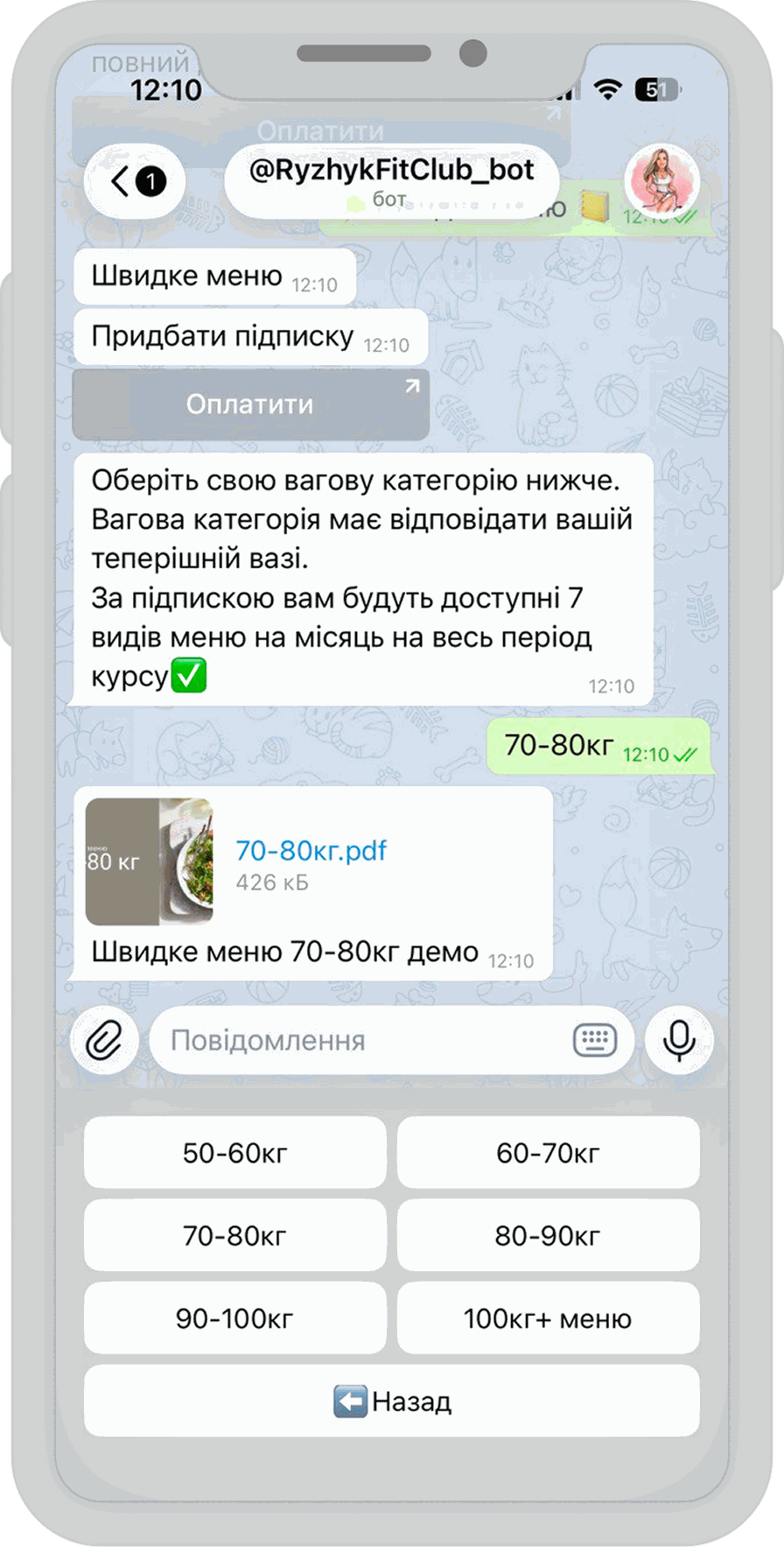
Scripted or AI. A scripted bot moves users through deterministic flows — menus, buttons, forms — right when the journey is known in advance: order, subscribe, book, register. RyzhykFitClub sells structured training programs and weight-category meal plans this way; no language model is needed to take a subscription payment. AI earns its keep where users ask questions no menu can anticipate — the Oazis Park bot answers driver candidates around the clock from a knowledge base and collects what HR needs. Many real bots are hybrids: scripted flows for the money path, AI for the questions around it.
Custom or builder-based. Custom code gives exact behavior; a builder assembles proven mechanics fast. The honest comparison:
| Approach | Build effort | Running cost profile | When to pick it |
|---|---|---|---|
| Scripted flow (custom code) | Moderate — flows, database, payments, integrations; no AI layer to tune | Lowest: hosting plus payment-provider fees; barely moves with volume | Predictable journeys where conversion matters: ordering, subscriptions, bookings |
| AI-powered (custom code) | Highest — everything scripted needs, plus knowledge-base prep, answer quality control, and handoff design | Hosting plus per-usage model costs that grow with conversation volume | Open-ended questions: support, recruitment, consultation — anywhere a menu would frustrate |
| Builder-based | Lowest — assembled from ready blocks, not written from scratch | Platform subscription — predictable, paid for as long as the bot lives | Speed beats uniqueness: validating an idea or launching standard mechanics on a deadline |
These choices compose. RyzhykFitClub runs on our builder because paid content, trials, and subscriptions are standard mechanics; Oazis Park is custom because AI answer quality and handoff rules are not. The right shape falls out of your process, not out of ideology.
How to Build a Telegram Bot for Business: 8 Steps
- Define the one job. Sell, support, retain, or hire — pick one, plus the number that proves it worked: paid orders, resolved questions, renewals, qualified applicants. Bots designed to do everything convert at nothing.
- Map the conversation flows on paper. Every path a user can take, before any code: the happy path, the typo, the abandoned cart, and a "talk to a human" exit reachable from everywhere.
- Set up the architecture. Register the bot, stand up the service, point the webhook at it, and design the database around users and their state. The two decisions above get executed here.
- Wire in payments. Decide the money model — one-off orders, subscriptions with a free trial, or code-based access — then connect a provider such as Stripe, PayPal, LiqPay, or WayForPay. Budget real time for edge cases: the card that fails mid-renewal, the refund, the double tap on "Pay".
- Connect your existing systems. Orders, leads, and customer data must land where your team already works — CRM, Google Sheets, an order or POS system — or someone will be re-typing chat output into spreadsheets by week two.
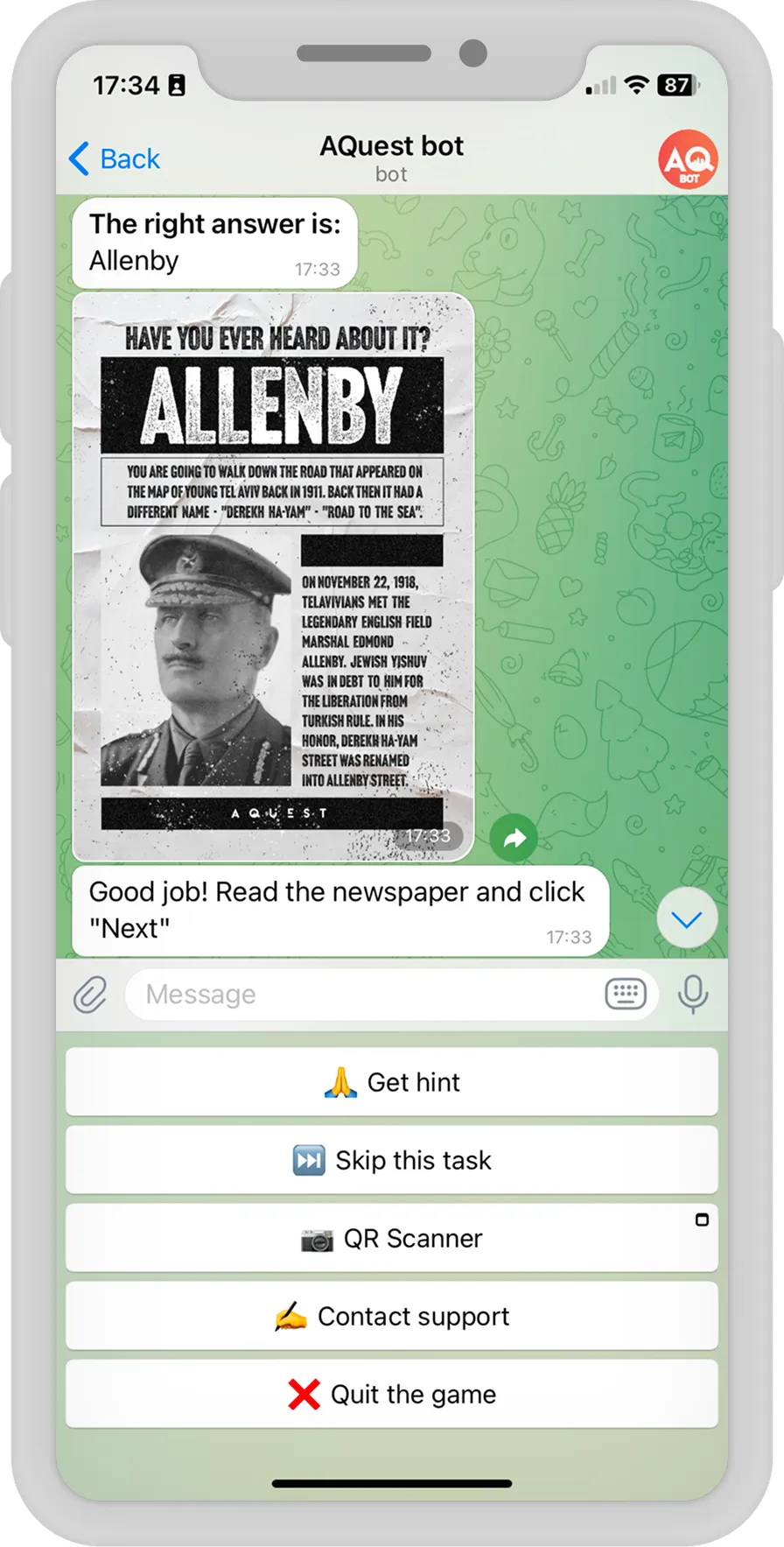
- Build the admin panel. A non-developer will need to change a price or add content. AQuest's quests are managed through an internal panel — content editing, marketing tools, user analytics — and the Oazis Park bot stays current with hiring policy the same way.
- Launch to a small cohort first. There is no app-store review: deploy, share a link or QR code, and the bot is live. Soft-launch anyway — a limited group will surface the flows you drew wrong while the audience is forgiving.
- Iterate on real conversations. Drop-off points, repeat purchases, and the literal questions users type are your roadmap. Updates reach everyone the moment you deploy — shipping weekly is realistic, not a slogan.
What Telegram Actually Supports for Business
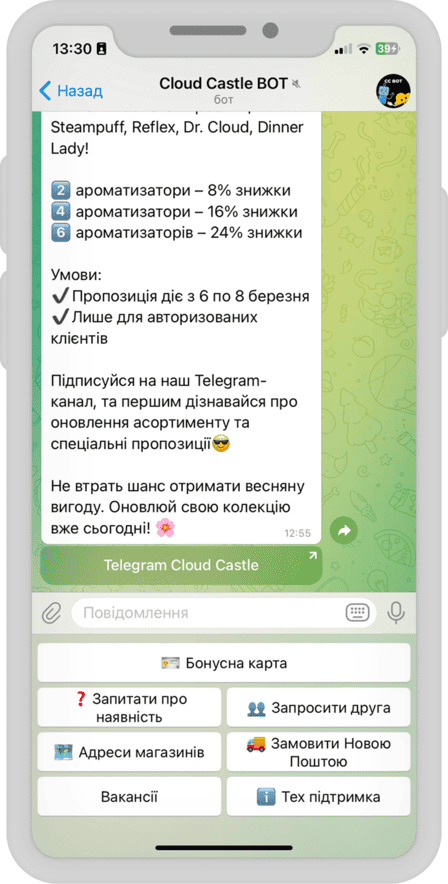
Everything below runs in a production bot we operate — not a feature list. Catalogs, ordering, and loyalty: the CC chatbot lets retail customers browse a 7,000-product catalog, place orders, locate the nearest of 59 stores, and manage a bonus card — a channel that has produced over $5M in income across 50,000+ customers. Subscriptions and gamification: RyzhykFitClub runs a full funnel from free trial to monthly subscription, with a prize wheel — iPhones and cash among the rewards — doing the retention work. Code-based access and QR: AQuest monetizes city quests in Israel through purchased access codes, with QR scanning, photo uploads, and trivia in the chat — live and earning for over six years. AI answers with human handoff: the Oazis Park bot works from a knowledge base under real-time quality control and flags a human instead of guessing. For event use cases, see how chatbots automate event logistics and ignite interaction.
How Much Work Is It, Honestly
A scripted bot with payments and one integration is a matter of weeks. An AI bot adds knowledge-base preparation and quality-control design; a builder-based launch is faster than either. The effort drivers: the flows from step two, the number of integrations, an AI layer or not, and the depth of the admin panel.
The trap to price in: a demo that greets users is an afternoon; a bot that survives a payday spike and a declined card is engineering. Bots that earn are maintained products — AQuest's six-plus years of revenue is as much a maintenance story as a launch one.
When a Telegram Bot Is the Wrong Tool
We tell clients this before contracts are signed. Skip the bot if your audience is not on Telegram — customers who live in WhatsApp, Viber, or Instagram Direct deserve a bot there instead; the flow logic transfers. Skip it if the experience is heavily visual — rich comparison and dashboards belong on the web or in an app. Skip it if a landing page with a form covers the job. And do not launch without an owner: a bot nobody updates answers last quarter's questions at last quarter's prices.
FAQ
Does a Telegram bot need app-store approval?
No. A bot is live the moment you deploy it; users reach it through a link, a username search, or a QR code, and updates take effect immediately for everyone.
Can a Telegram bot take recurring payments?
Yes. Subscriptions with free trials, one-off orders, and code-based access all run in production across our bots. Payments go through an integrated provider, and the subscription logic lives in your bot's backend.
Should my bot use AI?
Only where users ask questions you cannot predict. A defined product sells better scripted — faster, cheaper to run, and it cannot improvise a wrong answer. Support and recruitment justify AI, provided it escalates to a human when unsure.
Can the bot work with the systems we already use?
That is the normal case. Bots we ship push orders, leads, and applicant data into CRMs, Google Sheets, and order systems through their APIs; AI bots draw answers from your knowledge base the same way.
Which language or framework should we use?
The one your team can maintain in three years. Solid frameworks exist in every mainstream language, and the Bot API is identical underneath. Architecture, state design, and payment edge cases decide whether the bot holds up — the framework does not.
Where to Start
Be strict about step one: one job, one metric. Draw the flows, pick your column in the table, and build the smallest bot that completes the money path end to end. Or hand it to the team that has walked that route since 2017 — CC chatbot, AQuest, RyzhykFitClub, and Oazis Park are the proof: our Telegram bot development squad, honest wrong-tool advice included.