To build an internal knowledge base chatbot, connect a large language model to your company documents through retrieval-augmented generation (RAG): collect and clean the sources, split them into chunks, index them in a vector database, retrieve the relevant passages for each question, and make the model answer strictly from that context — with access control and human handoff built in.
That is the short answer. The rest of this guide covers each step, the architecture options, and the mistakes that quietly kill these projects. If you would rather skip the build and get the result, we do this as a service: see RAG knowledge-base assistant development, or browse our chatbot development services for the wider picture.
What an Internal Knowledge Base Chatbot Actually Does
An internal chatbot answers your team's questions from your own documentation instead of the open internet: HR policies, product specs, onboarding guides, support procedures, sales playbooks. Instead of asking a colleague or digging through five tools, an employee asks in plain language and gets an answer grounded in the current version of the document — ideally with a link to the source.
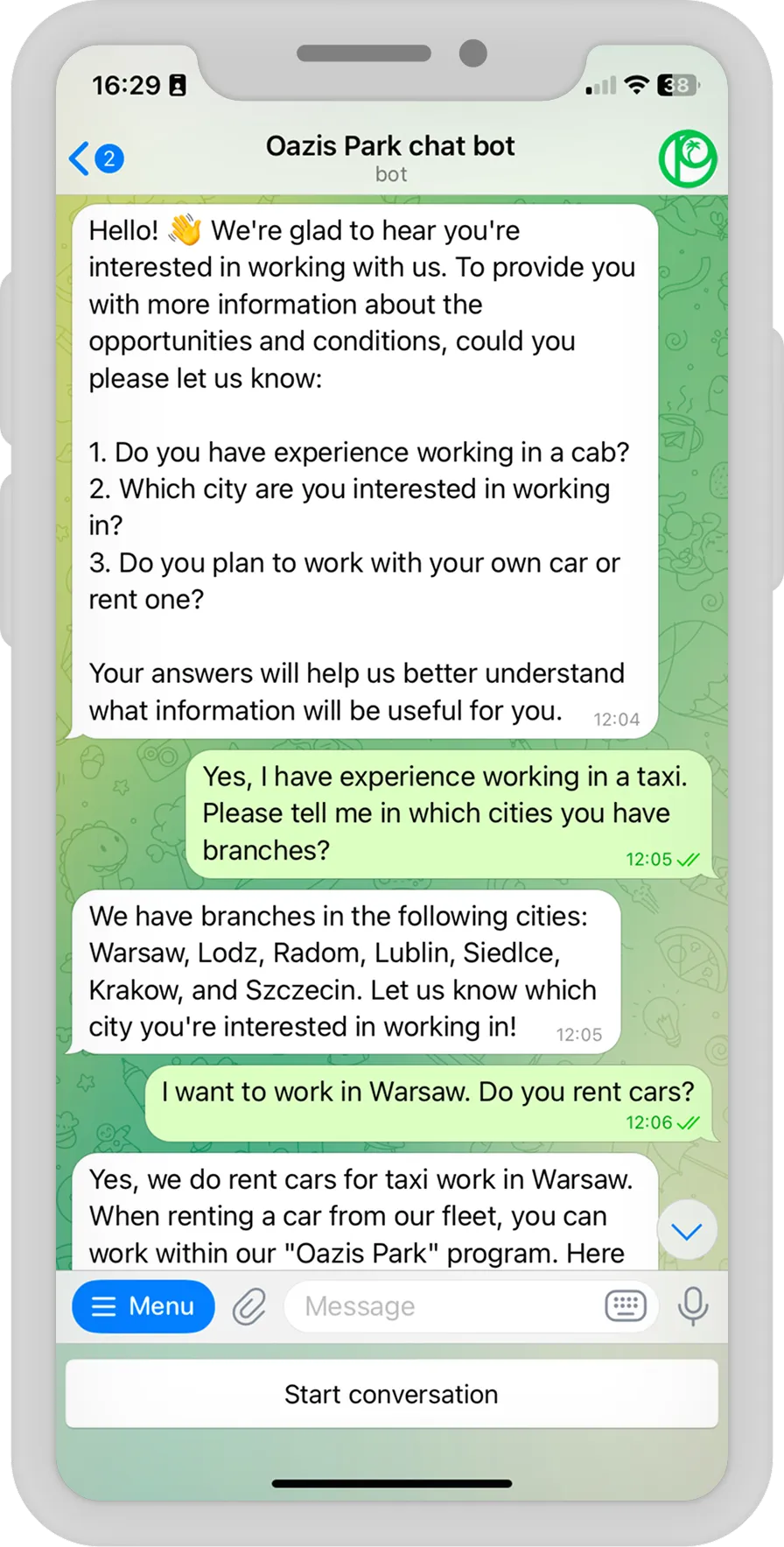
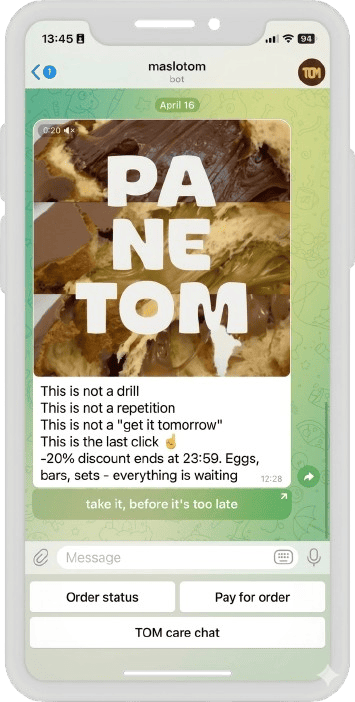
The same architecture also works outward-facing. For Oazis Park, a major Polish transportation company, we built a Telegram assistant that is available to driver applicants around the clock — walking them through open roles, answering their questions from the company's knowledge base, gathering what HR needs to move a candidacy forward, and pulling a manager into the conversation the moment a question falls outside its scope. For Maslotom, an AI assistant integrated with a live knowledge base and order system now handles 80% of incoming support requests automatically. The pattern is identical for an internal deployment; only the audience and the permissions change.
Why does this matter now? Because the underlying approach — RAG — has become the standard, well-documented way to give language models access to private knowledge. You no longer need a research team to build one. You do need engineering discipline, which is where most projects go sideways. More on that below.
Three Ways to Build One: RAG vs Fine-Tuning vs Off-the-Shelf
There are three realistic approaches, and the comparison looks like this:
| Approach | How it works | Strengths | Trade-offs |
|---|---|---|---|
| RAG (retrieval-augmented generation) | Documents are indexed in a vector database; relevant passages are retrieved and fed to the model with each question | Answers stay current when documents change; sources can be cited; no model training; permissions can be enforced at retrieval time | Answer quality depends heavily on document quality and retrieval tuning; requires real engineering to do well |
| Fine-tuning | A model is additionally trained on your data so knowledge is baked into its weights | Can teach tone, format, and domain vocabulary | Poor fit for factual company knowledge: retraining needed on every update, no source citations, no per-user access control, higher cost |
| Off-the-shelf tool | A SaaS product ingests your docs and provides a ready chat interface | Fastest start, no code, predictable subscription pricing | Limited control over retrieval, integrations, and data residency; hard to add custom logic like handoff rules or system integrations; per-seat costs grow with the team |
Our default recommendation is RAG, and it is not a close call for knowledge-base use cases. Fine-tuning answers a different question — "how should the model speak" rather than "what does the model know" — and a model with facts baked into its weights starts drifting out of date the day you deploy it. Off-the-shelf tools are a legitimate choice, and we say so outright in the build-vs-buy section below. But for anything that must respect who is allowed to see what, or plug into your CRM, HR system, or order database, RAG with custom logic is the approach that holds up.
How to Build an Internal Knowledge Base Chatbot: 7 Steps
- Audit your knowledge sources. List where the knowledge actually lives — wikis, Google Drive, Notion, Confluence, PDFs, ticket histories — and grade each source for accuracy. A chatbot trained on outdated policy documents will confidently give outdated answers. This step is unglamorous and it is the single best predictor of project success.
- Choose the architecture. For company knowledge, that almost always means RAG (see the table above). Decide early whether you can use a hosted LLM API or need stricter data-handling guarantees, because this constrains every later choice.
- Prepare and chunk the content. Clean the documents, strip duplicates and dead pages, and split the text into passages sized so that each chunk carries one coherent idea with enough context to stand alone. Naive splitting — cutting mid-table or mid-procedure — is one of the most common reasons retrieval returns garbage.
- Index and retrieve. Embed the chunks into a vector database and test retrieval on its own, before any chat interface exists: for twenty real employee questions, do the top retrieved passages actually contain the answer? If retrieval is wrong, no prompt will save you.
- Design the answering logic. The model should answer only from retrieved context, cite its sources, and say "I don't know" instead of improvising. Add a quality-control layer that flags low-confidence answers — in the Oazis Park bot, an unclear or complex question alerts a manager for immediate intervention rather than producing a guess.
- Wire in access, integrations, and handoff. Put the bot where people already work — Slack, Teams, Telegram, or your intranet. Enforce document permissions at retrieval time so the bot never reveals to an intern what was written for the leadership team. Connect live systems where answers depend on them: Maslotom's assistant is integrated with the order system, so "where is my order" gets a real answer, not a paraphrased policy.
- Test with real questions, then keep it maintained. Pilot with one team, collect the questions the bot failed, and fix the knowledge base — not just the bot. Give a non-developer an admin panel to update content; for Oazis Park, that is how the chatbot stays aligned with the company's latest hiring policies without a developer in the loop.
Notice that roughly half of these steps are about your content and processes, not about AI. That ratio is accurate, and treating this as a broader automation exercise pays off — we wrote about where automation delivers returns first in AI as a business partner: how intelligent automation transforms recruitment, retail, and support.
Build vs Buy: An Honest Answer
Buy an off-the-shelf tool if your documentation is clean, lives mostly in one place, and you need plain Q&A with no integrations. A SaaS knowledge-base bot will get you 70% of the value in days, and for a small team that trade is often correct. Take it and move on.
Build it in-house if you have engineers with real LLM experience and the time to own it long-term. The frameworks are mature and well documented. Budget honestly, though: the prototype is the easy 20%, and retrieval tuning, permissions, evaluation, and content upkeep are the recurring 80% that keeps living on someone's backlog.
Bring in a team like ours when the chatbot has to respect document-level permissions, integrate with your CRM, HR, or order systems, hand off cleanly to humans, and stay accurate as your documentation changes — and you want it built once, properly, without hiring for a capability you need for one project. That is exactly the scope of our RAG knowledge-base assistant service: we design the retrieval architecture, build the integrations, and leave your team in charge of the knowledge itself — content stays editable in-house, no developer in the loop. We are not contractors who ship and disappear — 3 out of 4 of our clients return with their next project, and support after launch is part of how we work.
Where These Projects Go Wrong
Hallucinations get discovered by users, not by the team. If you do not build refusal behavior and quality control in from the start, the bot will improvise, and employees will find out before you do. Trust, once lost internally, is very hard to win back — people simply stop using the bot.
The knowledge base rots. The bot is only as current as its sources. Without an owner and an easy update path, answers drift out of date within months and the project quietly dies. This is a process problem, not a technology problem, and no model upgrade fixes it.
Permissions are an afterthought. Indexing every document into one shared pool means the bot happily quotes salary bands to anyone who asks. Access control has to be designed into retrieval, not patched on after the pilot.
AI-generated code ships unreviewed. Much of the chatbot boilerplate you will find — or generate — works in a demo and fails under real load or real security scrutiny. We have seen enough of this to write about it separately: why AI-driven development must be supervised by experienced engineers. The same rule applies doubly to a system that speaks to your whole company with a confident voice.
FAQ
How long does it take to build an internal knowledge base chatbot?
A scoped pilot — one team, one or two knowledge sources, a chat interface in Slack or Telegram — is a project measured in weeks, not months. What stretches timelines is rarely the AI: it is cleaning up the documentation and agreeing on who owns it. A full rollout with permissions and system integrations is a larger engineering project, but it should still be incremental, with a working pilot early.
Can it use our existing docs in Notion, Confluence, or Google Drive?
Yes — that is the normal case. RAG pipelines ingest content from wikis, drives, PDFs, and databases through their APIs, and re-sync when documents change. The practical constraint is quality, not connectivity: if three conflicting versions of a policy exist, the bot will surface the conflict. Plan a content cleanup as part of the project.
How do we stop the chatbot from making things up?
Three mechanisms, used together: restrict the model to answering from retrieved passages only; require citations so every answer links to its source; and route low-confidence or out-of-scope questions to a human instead of letting the model guess. This is the same human-handoff pattern we shipped for Oazis Park — when the bot encounters an unclear question, it alerts a manager rather than improvising.
Do we need to train our own model?
Almost certainly not. RAG works with existing commercial or open-source models — the knowledge lives in your document index, not in the model weights. Fine-tuning is worth considering only for tone and formatting, and it never replaces retrieval for factual company knowledge.
Is our internal data safe with an LLM?
It can be, if you engineer for it. Use API providers with no-training data agreements or self-hosted models where required, enforce document permissions at retrieval time, and log which sources fed each answer. The risk is not the technology — it is skipping this design work and indexing everything into one unpermissioned pool.
Where to Start
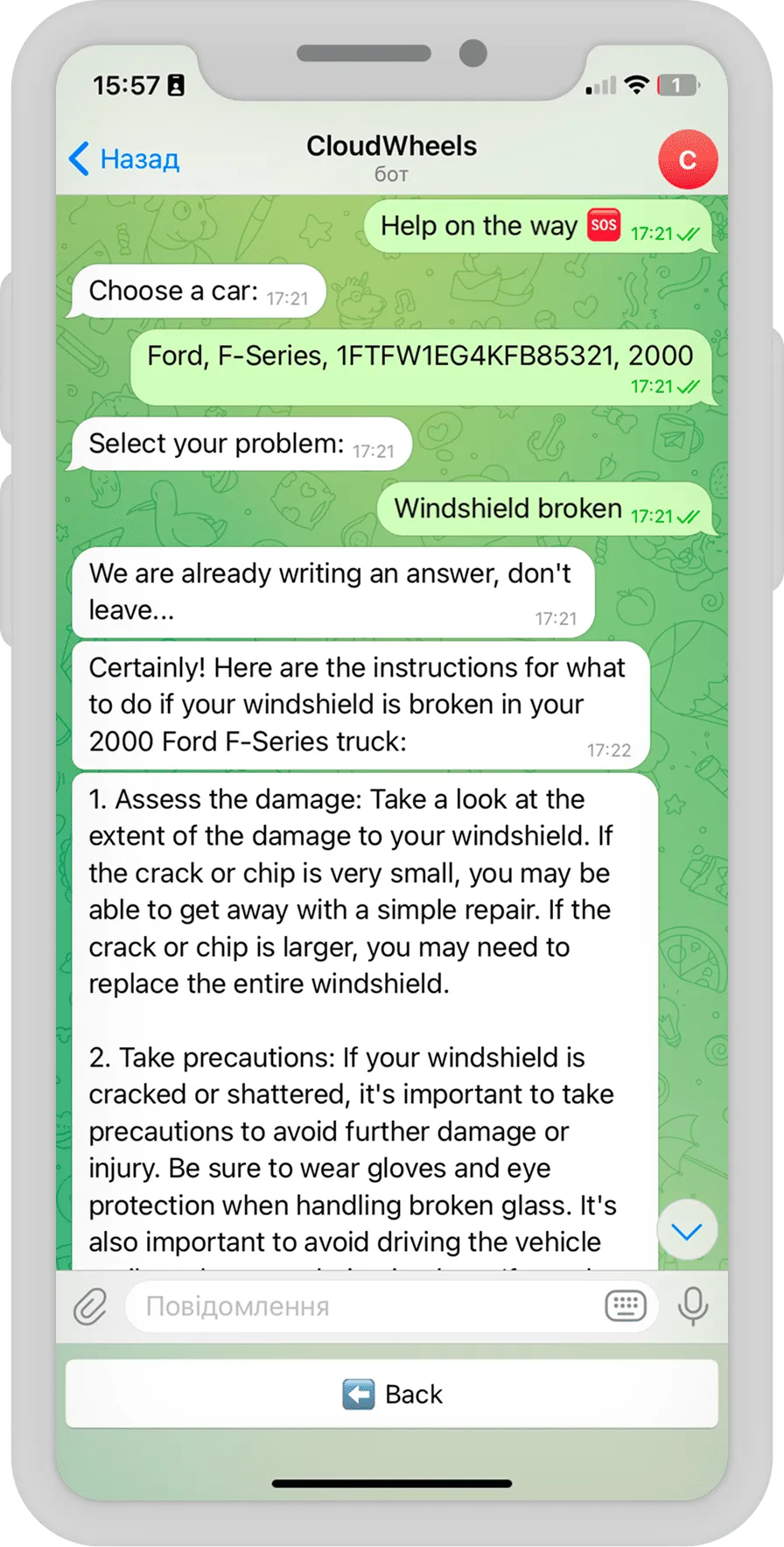
Start with the audit, not the model: pick one team with a real question load, list their knowledge sources, and run a small pilot against measurable success criteria — answer accuracy and how often people come back to the bot. If you want a partner for the whole path from audit to a maintained assistant, that is what we build: RAG knowledge-base assistant development from the team behind the Oazis Park and Maslotom assistants — and if your use case leans toward customer-facing support or CRM-integrated bots like CloudWheels, our chatbot development team covers that ground too.