Blog
- All categories
- Website development
- CRM Systems
- IoT Development
- UX/UI Design
- Quality Assurance
- Business Process Automation
- Marketing
- Chatbot development
- Artificial intelligence
- Software Development
n8n Automation for Polish & CEE Companies: Costs and Where to Start
Why the automation math looks different from Warsaw than from Boston: verified 2026 tool prices in a cost-sensitive market, EU data-location preferences that favor self-hosting, KSeF-era invoicing, the processes CEE companies automate first — and how to scope a realistic first quarter with a team that works in Polish, Ukrainian, and English.
Invoice Automation with n8n and AI: From Received PDF to Paid
An invoice arrives as a PDF nobody wants to retype — and leaves as a posted, matched, paid record. The complete lifecycle we build in n8n with AI extraction: intake, validation, human approval, posting, payment matching, chasing, and the error handling that makes it safe to run unattended.
n8n: 15 Workflows That Save 20+ Hours a Week
Fifteen workflows we actually build for clients — lead routing, CRM sync, AI email handling, document extraction, ticket triage — each with a conservative time-saved range and the visible arithmetic that sums them to 18–36 hours a week for a mid-size team.
n8n vs Make vs Zapier (2026): Exact Costs, Plans, and When Each One Wins
Zapier bills per task, Make per credit, n8n per execution — and that one difference decides the price at scale. A practitioner's comparison with verified 2026 plan prices, the billing math behind them, and an honest answer to when each tool wins.
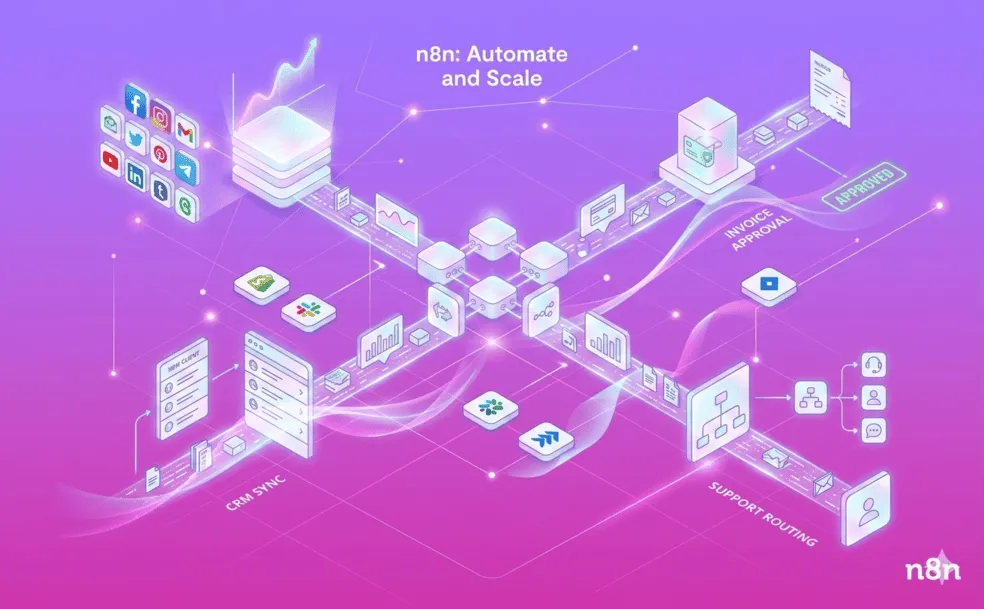
n8n Business Automation: A Fast and Cost-Effective Way to Start Digital Transformation
Learn how n8n helps automate business processes faster and at lower cost, without investing heavily in complex ERP or CRM systems at the start.

Why AI-Driven Development Must Be Supervised by Experienced Engineers
AI can dramatically accelerate development, but only in the hands of experienced engineers. Without proper supervision, vibe coding leads to critical mistakes in infrastructure, databases, containers, and dependencies, while the real losses appear later in production.