For companies in Poland and the wider CEE region, n8n is usually the automation platform that fits first: it self-hosts on your own EU server, its per-execution pricing suits cost-conscious operations, and a first working workflow is an engineering project of days — not an ERP program of quarters.
This is a market piece, not another how-to. We have already written those: which platform to pick is settled plan-by-plan in our n8n vs Make vs Zapier comparison, and what to build is cataloged in fifteen workflows with the time math shown. This article covers what those cannot: how the numbers and constraints shift when your company operates from Warsaw, Kraków, or Kyiv. The building itself is what our n8n development squad does, within our broader business process automation practice.
What changes when the buyer sits in Kraków, not California
Most automation advice assumes a market where software subscriptions are rounding errors; priced in złoty, they are not — finance directors here read the per-month column before the feature list. The entry prices frame it, as read from the vendors' pricing pages in July 2026 when we verified them for the comparison above: Zapier's Professional from $19.99 a month for 750 tasks, Make's Core from $9 for 10,000 credits, n8n Cloud from €20 — roughly 85 PLN at current rates — for 2,500 executions, plus a Community Edition that self-hosts for free without execution limits. A billing unit that does not grow with every added step — and a floor price of zero — is what a cost-sensitive budget hangs on.
Data location bends the same direction. Many Polish and CEE companies arrive with an EU-data-location preference before any tool is named — a GDPR-driven policy, a client contract, or simply the instinct not to route customer records through an overseas cloud on every run. Of the mainstream platforms, only n8n runs entirely on infrastructure you choose: a VPS in Warsaw, a Frankfurt region, the rack you already rent. For teams with that constraint, the shortlist was never long.
The third shift is build economics. An automation budget is mostly engineering hours, and hours are priced regionally — the same rate logic we unpacked for the Polish chatbot market applies here unchanged. A custom-built workflow that looks like a luxury at US agency rates is a routine month-one project here — which is why the case for starting with targeted automation instead of a heavyweight ERP or CRM program lands with particular force in this market: the careful path is not just lower-risk, it is genuinely cheap.
Three ways to run automation, priced for this market
Strip the logos away and the real choice is between three deployment models:
| SaaS automation (Zapier / Make) | n8n Cloud | n8n self-hosted | |
|---|---|---|---|
| Software cost (July 2026) | Zapier from $19.99/mo for 750 tasks; Make from $9/mo for 10,000 credits | From €20/mo (~85 PLN) for 2,500 executions | €0 — free Community Edition; you pay for a small EU VPS |
| Where workflows and data run | The vendor's cloud, on every run | n8n's managed cloud | Your server — Warsaw, Frankfurt, or your own rack |
| Who maintains it | The vendor | Vendor runs the platform; you own the workflows | You or a partner: updates, backups, credential security |
| Fits best | A few simple links between popular SaaS tools | Serious volume without server ownership | Data control, high volume, custom code — the typical CEE endgame |
Vendors reshuffle tiers constantly, so treat the price cells as July-2026 orientation, not a contract — the plan-by-plan detail lives in the comparison. What the table cannot show is the proportion that matters: on any of the three, software is the small line. The real budget is engineering days — process design, integrations, error handling — and that is precisely the line regional rates compress.
What CEE companies automate first
Across our audits and builds in the region, first projects cluster in a few places — the full fifteen-entry catalog with per-workflow arithmetic stays in its own article; this is where regional demand concentrates:
- Recruitment and candidate communication. High-churn sectors — transport, logistics, retail, gastronomy — answer the same candidate questions every day, in Polish, at all hours. The region's most underrated automation surface — named case below.
- Invoicing, now that KSeF changed the terrain. Poland is moving invoicing onto structured data through the national KSeF system — which turns every invoice into machine-readable input an automation can act on. The full lifecycle build is in our invoice automation guide.
- Messenger-first operations. Business in CEE runs on Telegram, WhatsApp, and Viber to a degree Western playbooks underestimate; routing order updates, alerts, and sales funnels through the chats customers already open pays off immediately.
- Lead intake from many small channels. A typical Polish SME collects inquiries from its website, marketplaces, price-comparison portals, and social ads at once. Consolidating them into one CRM with a fast first response is the most requested first workflow we see.
- Reporting across tools that do not talk. Universal everywhere — but in companies mixing local accounting software with global SaaS, the manual glue is thicker and the payback correspondingly faster.
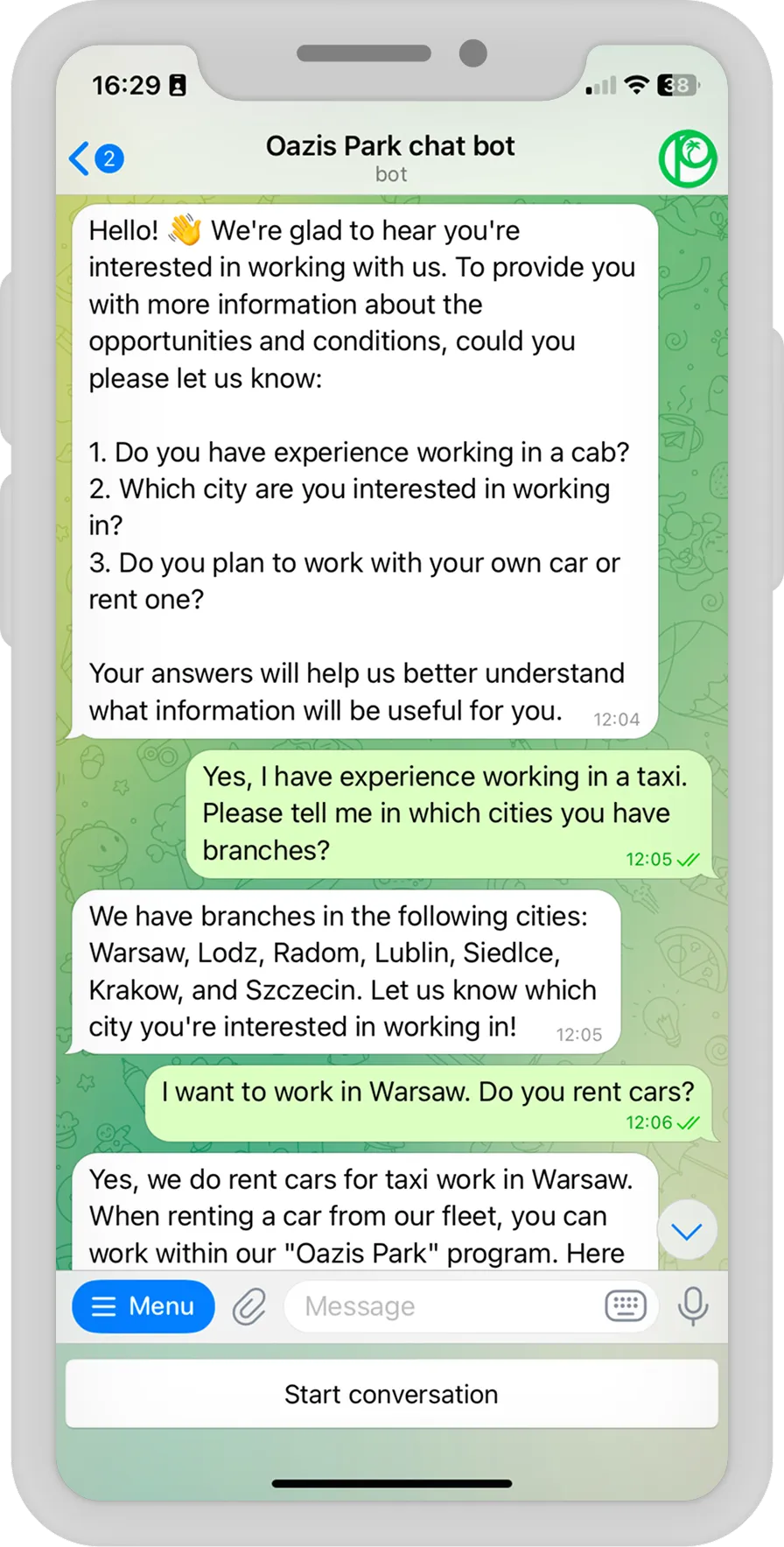
The recruitment entry has a name attached. Oazis Park, one of Poland's major transport companies, was drowning in repetitive candidate inquiries, so we built an AI-powered Telegram assistant that supports driver candidates around the clock: it walks them through open job options, answers standard questions from its knowledge base, and collects the data HR needs — and it does not guess, escalating anything unclear to a human recruiter immediately. An admin panel lets the company update content as hiring policy changes. The outcome was practical: faster hiring, a lighter HR workload, candidates answered at 11 p.m. — not a moonshot, a bottleneck removed.
How to scope the first quarter
A quarter is the honest unit for a first automation engagement — long enough to put two or three workflows into production, short enough that nobody is buying a transformation program on faith. The shape we recommend:
- Weeks 1–2: audit with numbers, not opinions. Pull real volumes from systems you already have — inquiries per week, invoices per month, reports assembled by hand — and rank processes by hours consumed and cost of errors. The winner is rarely the process anyone complained about first.
- Settle the data question before the tool question. Decide what may leave your infrastructure. The answer filters the deployment models above in one step — and if it is "customer data stays with us," provision the EU server first and build on it from day one.
- Month 1: ship one workflow where volume is obvious and failure is cheap. Into production, not a demo environment. A workflow that visibly runs buys more internal trust than any slide deck.
- Month 2: add the second workflow, and the safety net around both. Error branches, retries, alerts into the channel your team actually reads — the step DIY automation skips first and regrets first.
- Month 3: hand over, then decide from data. Documented workflows, admin access, training for the process owner — and a read of the execution counts to decide what earns the next quarter. If the numbers say stop, stop.
What does such a quarter cost? There is no public price list — scope decides — but the shape is knowable: engineering days at regional rates, software from the smallest column of the table, a server bill closer to a phone plan than a license fee.
A nearshore partner that works in your language
For Polish and CEE companies, the practical advantage of hiring in-region is not the rates — it is that nothing gets lost. Our engineering is rooted in Kyiv, one hour from Warsaw's clock, so questions are answered inside your working day rather than overnight. This site — and our project communication — runs natively in Polish, Ukrainian, and English, which matters more in automation than almost anywhere: workflows encode your process, and your process is described in your language, by your people.
Since 2017 our squads have shipped software for clients in eight countries, with Poland on that list from early on, and three out of four clients come back with a next project. How an engagement runs — discovery first, working software every week or two, a product manager as your single point of contact — lives on our how we work page.
Frequently asked questions
What does n8n automation cost for a Polish company in 2026?
Two lines: software and engineering. Software is the small one — from €20 a month on n8n Cloud (about 85 PLN) down to effectively zero self-hosted, per the July-2026 prices above. Engineering is the real budget, billed at regional rates, and it scales with integrations and edge cases, not company size. A first production workflow is typically days of work; the quarter plan above is a bounded, quotable project.
Does GDPR require us to self-host our automation?
No. GDPR requires knowing where personal data flows and having the right agreements with every processor — SaaS automation can be operated compliantly. But when workflows run on your own EU server, the data-location chapter of a compliance review shrinks to a sentence — which is why many CEE companies choose self-hosting unforced.
Can we run the project in Polish?
Yes. We work in Polish, Ukrainian, and English — this site runs natively in all three — and project communication happens in whichever language your team prefers. Requirements, documentation, and handover training need no translation layer.
Can n8n work with KSeF?
Yes, as the orchestration layer. There is no official ready-made KSeF node, so the integration usually goes through your accounting platform's API or a custom code step — routing structured invoices through approvals, reconciliation, and reminders around the system of record. Closing that kind of gap is routine work for a development-first team; the pipeline anatomy is in our invoice automation guide.
Is our company too small for automation to pay off?
Headcount is the wrong dial; volume is the right one. A ten-person e-commerce operation processing hundreds of orders a month has more to automate than a fifty-person consultancy issuing twelve invoices. If a process is high-volume, repetitive, and owned by someone, it qualifies — and if it is not, we will say so before you spend money.
Where to start
If this reads like your situation — złoty-denominated budgets, data that should stay in the EU, processes described in Polish — bring us one process. The audit-first quarter above is how our n8n development squad runs first engagements, with business process automation as the wider map. Discovery takes one call and a short brief; you leave with a scoped first quarter, priced against your real volumes.