An AI customer-support chatbot answers routine customer requests from your own knowledge base, around the clock, and hands anything uncertain to a human. The return is arithmetic, not magic: tickets per month, minutes per ticket, loaded cost per hour, and the share the bot automates — 80% in our most mature deployment, 30–40% as a sane first-quarter plan.
I sit in the calls where these projects get scoped, and the budget conversation turns on two questions: what does the bot take off the team's plate, and what is that worth per month? This guide answers both with a model you can rerun on your own numbers — and settles the channel question (WhatsApp, Telegram, Viber, or a website widget) along the way. For your specific queue, start at our AI support assistant page or the wider chatbot development services.
"Support chatbot" is three different machines
Most disappointment in chatbot support comes from buying one level of automation while expecting the results of another. The phrase covers three different machines, and the first scoping decision is which one you are discussing:
| Level | What the bot does | What it is worth |
|---|---|---|
| 1 — FAQ deflection (scripted) | Answers fixed questions through menus and button flows, collects contact details, logs tickets. No language model anywhere. | Takes the repetitive floor off the queue at the lowest cost — but any question phrased outside the script escalates. The ceiling is low and hard. |
| 2 — AI on your data | A language model answers in natural language from your live documentation and catalog, escalates on low confidence, and ships with an admin panel. | The ceiling lifts: rephrased questions no longer break it, and automation reaches most informational tickets — where a support bot starts changing staffing math. |
| 3 — Full order actions | Everything in level 2, plus write access to your systems: cancels orders, tracks and reschedules delivery, manages loyalty — integrated with the order system, CRM, or POS. | Tickets get resolved end to end, not just answered. This is where 80% automation lives — and where the support channel starts producing revenue, not only savings. |
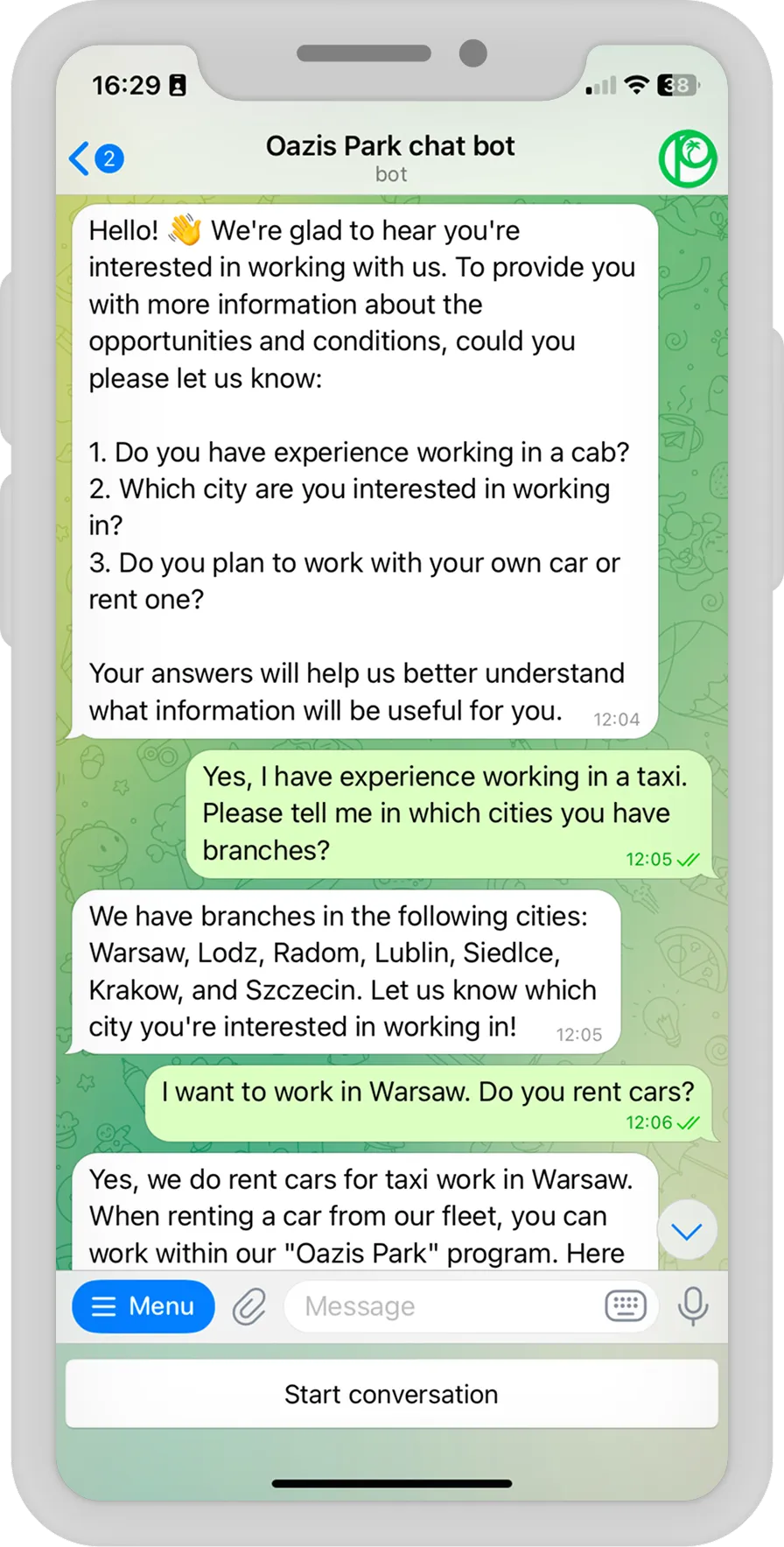
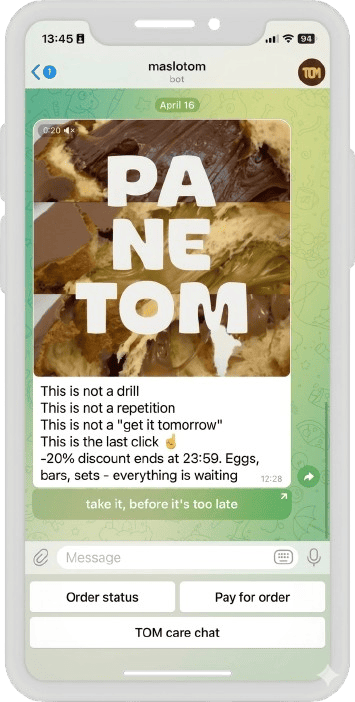
Our production work maps onto this ladder. For Maslotom, the assistant answers product questions and shows current promotions, but also cancels orders, updates statuses, and handles delivery questions — it is integrated with the live knowledge base and the order system. That is a level-three machine: 80% of incoming requests are handled automatically, and most users never realize they are talking to a bot. Our chatbot for a premium vaping retailer pushes the same level into full commerce — 7,000 products, 59 stores, 50,000+ customers, over $5 million in revenue through the chat channel — with support living inside the same conversation as ordering. For Oazis Park, a major Polish transport company, the level-two pattern serves a different queue: driver candidates get answers from the company's knowledge base 24/7, and anything unclear alerts a manager in real time. The math does not care whether the people asking are customers or applicants.
What each level costs
Deliberately short, because the full pricing breakdown is already published: How Much Does a Custom AI Chatbot Cost in 2026? walks through the market's cost bands and the seven factors that move a quote, and I will not repeat its tables here. For the ROI model below you need two numbers from that exercise: the build quote and the monthly running cost. They move differently — a scripted level-one bot runs on hosting and platform fees, while levels two and three carry a model bill that grows with every conversation, plus the upkeep of the knowledge behind the answers. Insist on both from every vendor: comparing builds while ignoring the monthly line is how support bots end up costing more than the work they replace.
The ROI math: a worked model, not a quoted statistic
Plenty of pages claim chatbots cut support costs by some confident industry percentage, attributed to studies you can never quite locate. I will not add to them. Here is the model instead — four numbers, all of them yours:
- T — tickets per month. Your help desk or shared inbox already knows this number.
- M — minutes per ticket. Blended handle time, including the back-and-forth, not just the first reply.
- C — loaded cost per hour. Salary plus taxes, tooling, and management overhead. Loaded, not gross.
- A — automation share. The fraction of tickets the bot resolves without a human. The entire argument lives here.
Monthly saving = T × M ÷ 60 × C × A. Worked with illustrative inputs — assumptions to replace, not industry facts: 2,000 tickets a month at 6 minutes each is 200 hours of handling. At a loaded $30 per hour, first-line support costs $6,000 a month before any automation. At a conservative 30–40% automation share, the bot returns $1,800–2,400 a month — roughly $22,000–29,000 a year. At Maslotom's 80%, the same queue returns $4,800 a month.
Now the number that deserves scrutiny: the 80%. It is real — measured in production, on an assistant wired into a live knowledge base and order system. It is also a mature deployment on well-maintained knowledge, not a launch-week result. Plan your first quarter around 30–40% and treat everything above that as earned — the levers in the next section are how you earn it. A vendor promising 80% from day one is quoting our destination as your starting point.
Payback follows by division. Take a hypothetical $40,000 level-two build — an illustration, not our price list: at the conservative band it pays back in 17–22 months; at 80% automation, in about eight. Same build, same queue. The automation share, not the build quote, decides the ROI — which is why the cheapest bid so often loses the math: a bot that automates half as much is a bad trade at any discount.
Two honest footnotes. The model understates the upside: it prices none of the 24/7 coverage, the instant first response, or the revenue a chat channel carries once it does more than answer — the $5 million through the vaping retailer's bot was sales, not savings. It also understates the downside of a bad scope: model usage and knowledge upkeep are real monthly costs, and a bot nobody trusts automates nothing.
Eight levers that move the automation share
When the share disappoints, the cause is almost always on this list:
- Knowledge freshness. An assistant answering from last quarter's catalog manufactures escalations. Maslotom's bot shows current promotions because it reads a live knowledge base, not an export from launch week.
- Integration depth. Reading answers questions; writing resolves tickets. "Where is my order?" is deflection. "Reschedule my delivery" closed without a human is resolution — and resolution moves the share.
- Handoff design. A bot that admits uncertainty and pulls in a person keeps the customer's trust — and trust keeps people using the bot at all. At Oazis Park, an unclear question alerts a manager immediately; the escape hatch is a feature, not a failure.
- Content ownership. If every answer edit is a developer ticket, the knowledge rots. An admin panel lets support or HR update content the same day — the way Oazis Park's team maintains its own hiring policies.
- Scope discipline. Launch on your top ticket intents and route the long tail to humans by design — ten things done well beat forty done plausibly.
- Channel coverage. The share is measured against all requests, not the ones that reach the bot. If customers write to you on WhatsApp and the assistant lives only on your website, the share is capped before quality even enters the picture.
- The analytics loop. Log the questions, the escalation points, and the answers users abandon, then feed that back into content and retrieval every week. The gap between 40% and 80% is closed by this loop, not by a bigger model.
- Guardrails. The assistant answers only from approved content, stays on topic, and declines what it was never meant to handle. One confidently wrong answer costs more trust than fifty correct ones earn back — and once people route around the bot, the share collapses.
WhatsApp, Telegram, Viber — or your website?
Half our inquiries phrase the project as a channel: "we need a WhatsApp support bot." The honest reframe: you need a support assistant, and WhatsApp is one of its doors. One assistant with one knowledge base serves every channel — we deploy the same core to Telegram, WhatsApp, Viber, Instagram Direct, and website widgets, so an answer updated once is updated everywhere.
Choosing the first door is simpler than the market makes it sound: launch where your support requests already arrive. If customers message your WhatsApp business number today, that is the launch channel. A website widget catches pre-sale visitors who will not install anything. Viber and Telegram dominate particular markets — your own inbox will tell you which applies more reliably than any global statistic. The bots above run on Telegram because that is where those audiences were; the pattern is channel-agnostic.
Two engineering notes. Each platform carries its own session rules, message constraints, and review process — a line item to budget, not a strategy problem. And escalation must carry full conversation history whichever door the customer used, so your agent picks up mid-conversation. Multi-channel is usually phase two: prove the automation share on one door, then open the next.
When a support chatbot is the wrong buy
Run the model before you talk to anyone, including us. If the monthly saving is a three-digit number, a shared inbox with good macros wins — and we say so in first calls, even when it costs us the project. Two more disqualifiers we check early. If the answers are not written down anywhere, there is nothing for an assistant to answer from — that is knowledge work before bot work; our RAG knowledge-base assistant page describes what the assistant needs to read from. And if the support process changes every week, stabilize it first: a bot is an amplifier, and it amplifies chaos as readily as order. On where AI automation pays off first, we wrote a separate piece covering recruitment, retail, and support.
Frequently asked questions
How much does an AI customer-support chatbot cost?
It depends on which of the three levels you are buying: scripted FAQ deflection, AI on your data, or full order actions with system integrations. We keep the numbers in one place — the cost guide linked above covers the market bands and what moves a quote. Whatever the level, insist on the monthly running cost next to the build price.
What share of support requests can a chatbot handle automatically?
Our most mature production deployment handles 80% of incoming requests automatically — Maslotom's assistant, which reads a live knowledge base and executes order actions. The figure was earned over time on well-maintained content. For a first deployment, model 30–40% and treat the eight levers above as the roadmap upward.
Is 80% automation realistic for a new bot?
Not in the first weeks, no. It is the compound result of live integrations, current content, a working handoff, and an analytics loop that keeps tuning what the bot knows. Model conservatively, measure from day one, and raise the target as real data comes in.
Should the bot launch on WhatsApp or on our website?
Wherever your support requests already arrive — that is the whole rule. The same assistant and knowledge base serve WhatsApp, Telegram, Viber, Instagram Direct, and a site widget alike, so the first channel is a data question, not an architecture commitment. Add the second door once the first has proven its automation share.
What happens when the bot does not know the answer?
It escalates instead of improvising: the conversation goes to a person with full history preserved. At Oazis Park, a manager is alerted in real time the moment a question falls outside the bot's scope; those escalations feed the analytics loop and become the next content update. A good support bot is a filter, not a wall.
How do we measure ROI after launch?
Replace the model's assumptions with logs: the real share resolved without a human, the real handle time on what still escalates, your real loaded cost — then recompute the saving. The assistant's own analytics show the most common queries and the weak spots to fix. ROI here is a monthly recalculation, not a launch-day claim.
Where to go from here
Since 2017 we have shipped this pattern for retail chains, transport companies, and commerce brands across eight countries, and three out of four clients come back with a next project — a statistic we protect by saying "you do not need this yet" whenever the model says so. On a support project you work with our dedicated Chatbot/AI/IoT squad — three developers plus a product manager as your single contact from scoping to production. Bring your ticket counts to the first call — with real numbers the model takes ten minutes, and the output is which level your queue needs and what it is worth per month. Start at AI support assistant development, or zoom out to chatbot development services first.